Whales and the gulf
The pilot whales of the gulf
Black, round-headed and almost always in company, long-finned pilot whales are the whales you are most likely to meet off Cape Breton's western shore in summer.
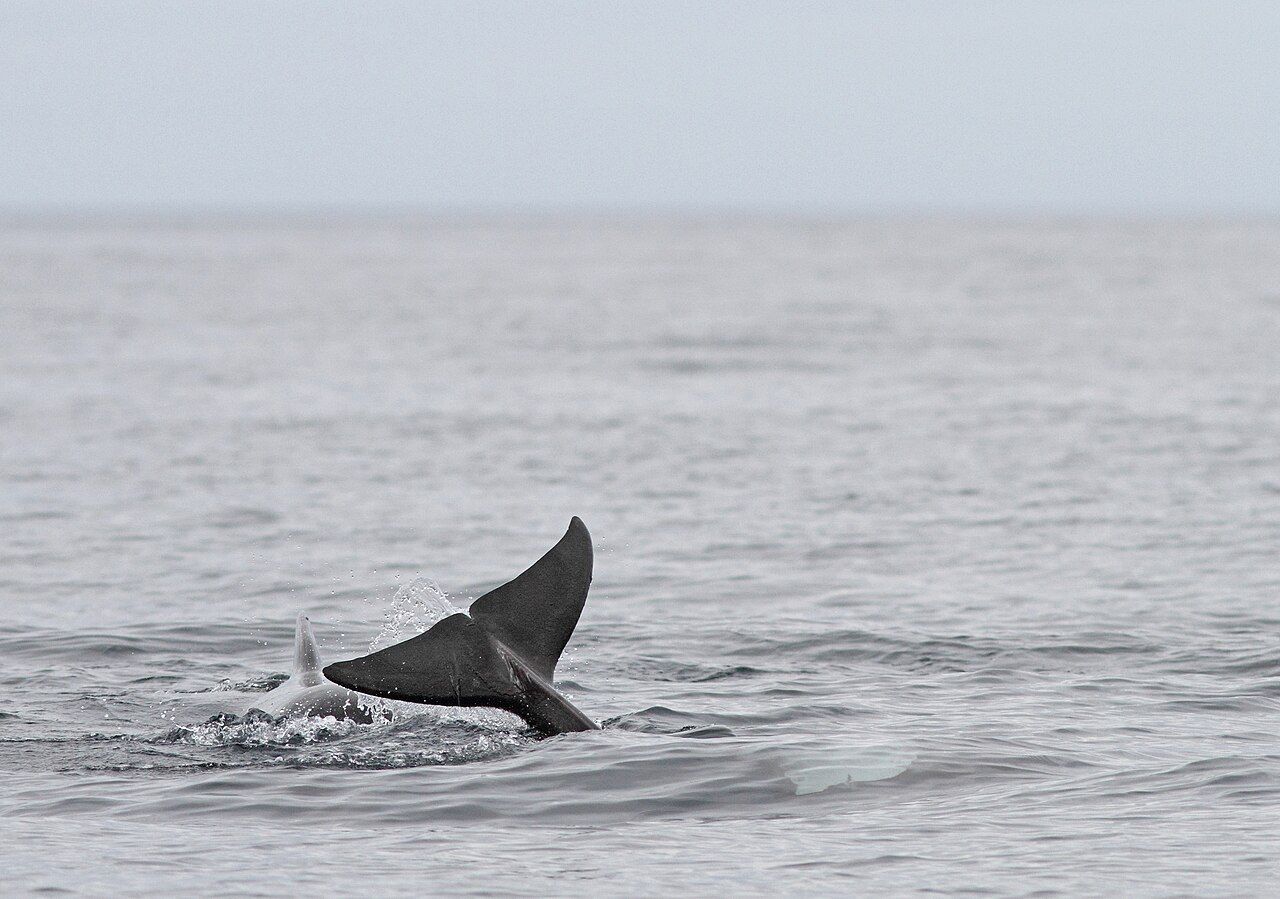 Photo by Bouke ten Cate; CC BY 4.0 (source file)
- Getting there
- Gulf waters off the Cabot Trail's west coast
- Bring
- Binoculars, a warm layer, patience
- At sea
- Pods often travel close to the cliffs on calm days; a north-west wind quickly raises a chop that hides their low fins.
- From Chéticamp
- Offshore from the harbour, all summer long
Stand on any headland between Chéticamp and Pleasant Bay on a still summer morning and there is a fair chance that the first whales you see will be pilot whales. They rarely travel alone. A line of short, curved black fins breaks the surface together, a few heads rise, a soft puff of breath carries across the water, and then the group slides under and moves on. Long-finned pilot whales spend the warmer months in the Gulf of St. Lawrence, and the deep water off the island's western shore is one of the better places in eastern Canada to watch them.
What a pilot whale looks like
Despite the name, the long-finned pilot whale (Globicephala melas) belongs to the dolphin family, and is one of its largest members. Adults are dark grey to black, with a rounded, bulbous forehead and almost no beak. Males grow larger than females, reaching around six metres or a little more, and carry a broader, heavier dorsal fin. Females are usually closer to five metres.
The dorsal fin is the feature to learn. It sits well forward on the back, is low and broad at its base, and curves backwards like a hook. When several animals surface together, the fins look like a row of dark sails. The long, sickle-shaped flippers that give the species its name are rarely seen from shore, but close views sometimes show a paler grey saddle behind the fin.
Pilot whales are not acrobats in the way humpbacks are. You are more likely to see them logging, lying still at the surface in a loose raft, or spyhopping, rising head first to look around. Calves stay tight against their mothers and often surface in step with them.
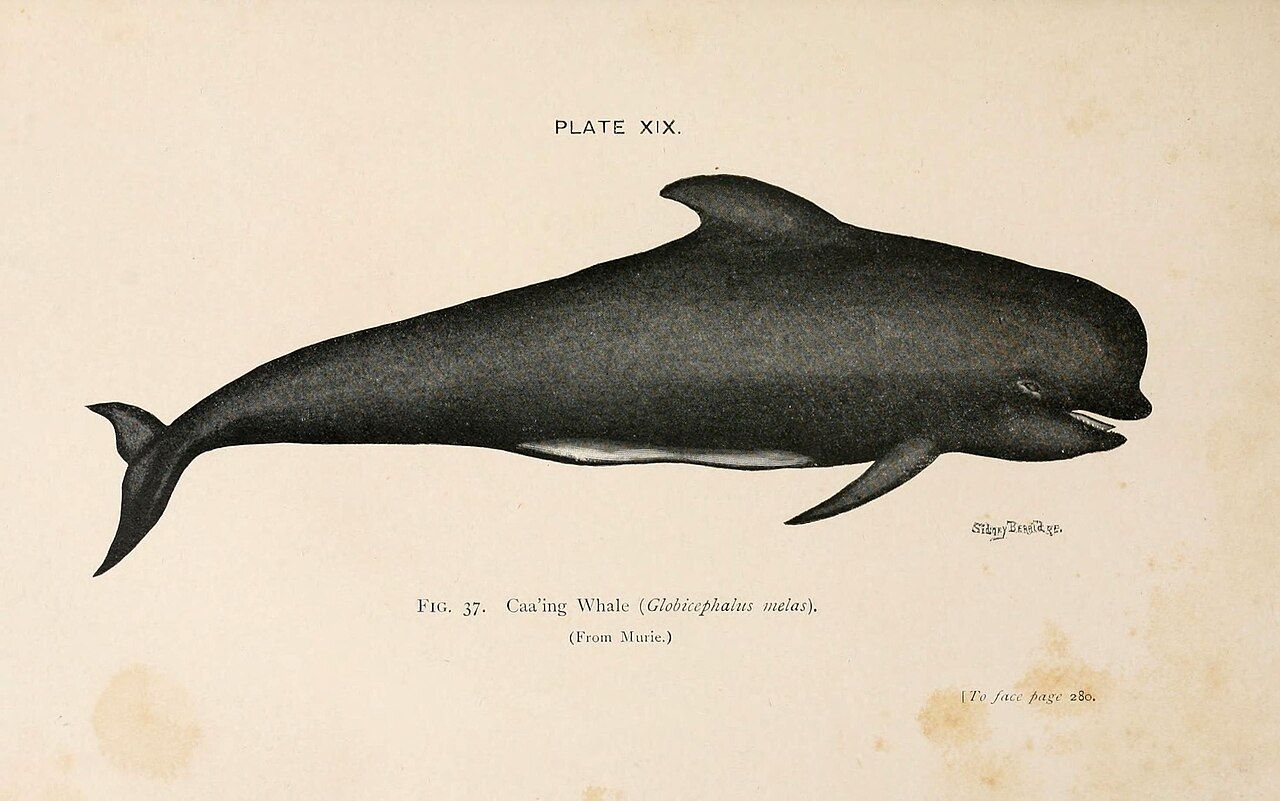 Photo by Biodiversity Heritage Library; CC BY 2.0 (source file)
Family groups and their calls
The striking thing about pilot whales is how social they are. Individuals of both sexes appear to stay with the group they were born into for long periods, so a pod can hold several generations of related females, their young and adult males. Groups of ten to twenty are common, and several pods sometimes travel together in much larger gatherings.
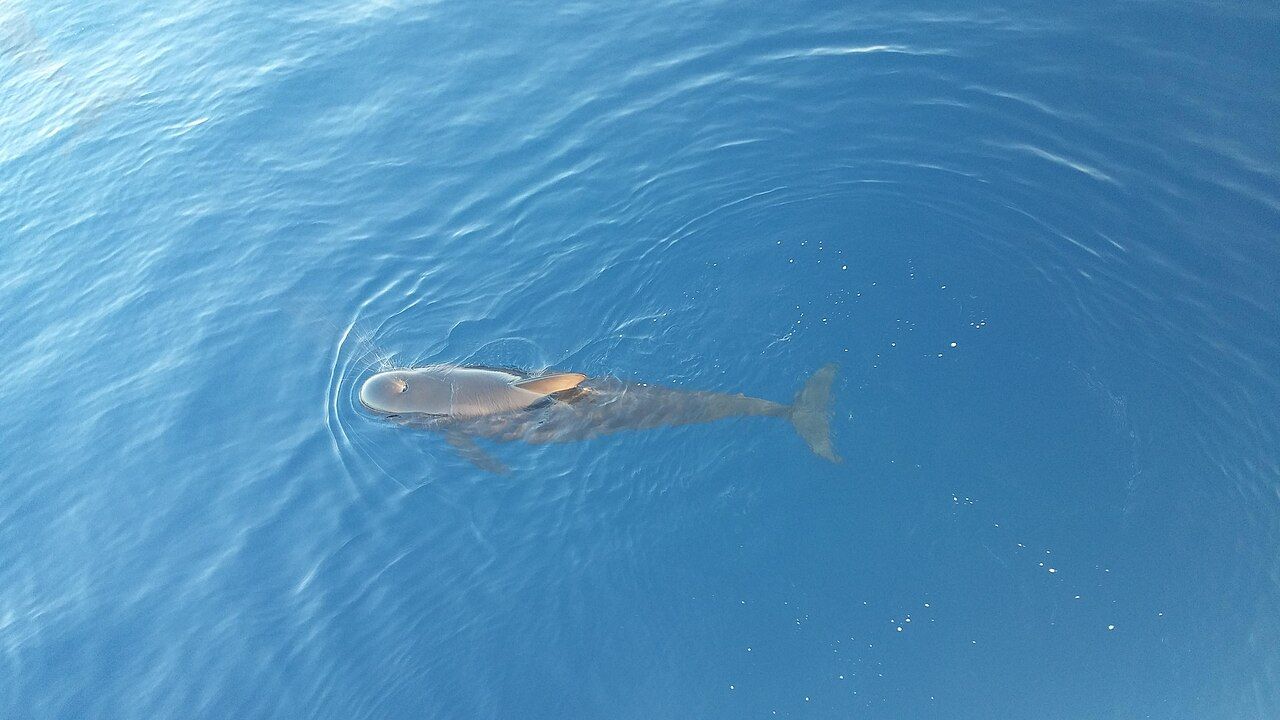 Photo by Ivane Pairaud; CC BY 4.0 (source file)
Those bonds are held together by sound. Pilot whales use a wide range of whistles, pulsed calls and clicks. The clicks work as echolocation, letting the whales find squid and fish in deep, dark water, while the whistles and calls seem to keep group members in touch. Scientists have recorded pilot whales off Cape Breton for years, and the work suggests that calls carry information about who is calling and what the group is doing, though much is still unknown.
Squid is the main food, and summer is when squid move into the gulf in numbers. Pilot whales follow them, which is why sightings off the west coast build through July and August and can carry on into the autumn. Much of their feeding happens on deep dives, out of sight, so the whales you watch at the surface are often resting, travelling or socialising.
Where and when to look
Pilot whales can turn up anywhere along the gulf shore of Cape Breton, but the stretch from Chéticamp north to Pleasant Bay is where they are most regularly reported. The coast here drops quickly into deep water, and the high ground of the Cape Breton Highlands gives you a natural grandstand. The headland at the end of the Skyline Trail is a well-known place to watch them from above, and several roadside lookouts on the climb north of Chéticamp give long views over the same water.
Calm conditions matter more than anything else. On a flat sea, a pod's fins and blows show a long way off; with whitecaps, they vanish. Early morning and evening often bring the smoothest water. Scan slowly in a band just beyond the cliffs, and watch for gulls or gannets gathering, which can mean fish and whales below. The season runs roughly from late June into October, though no month comes with a guarantee. Lookouts are covered in more detail in the guide to watching whales from the cliffs.
Further along the coast: Minke and fin: the gulf's two rorquals
Calm conditions matter more than anything else.
How close is too close
Pilot whales are often curious and sometimes approach boats, which makes them easy to crowd. Canada's marine mammal rules make it an offence to disturb whales, and they set minimum approach distances for vessels, generally at least 100 metres from whales in most waters, with larger distances for some species and areas. The rules apply to kayaks and other small craft as well as larger vessels.
If whales come towards you, the right response is to slow down or stop, shift into neutral and let them pass. Never move into the path of a pod, split a group, or come between a mother and calf. A group that keeps changing direction, stays down for long periods, or slaps the water may be disturbed. Paddlers should stay close to shore and give pods plenty of room. There is more on this in how to watch whales well.
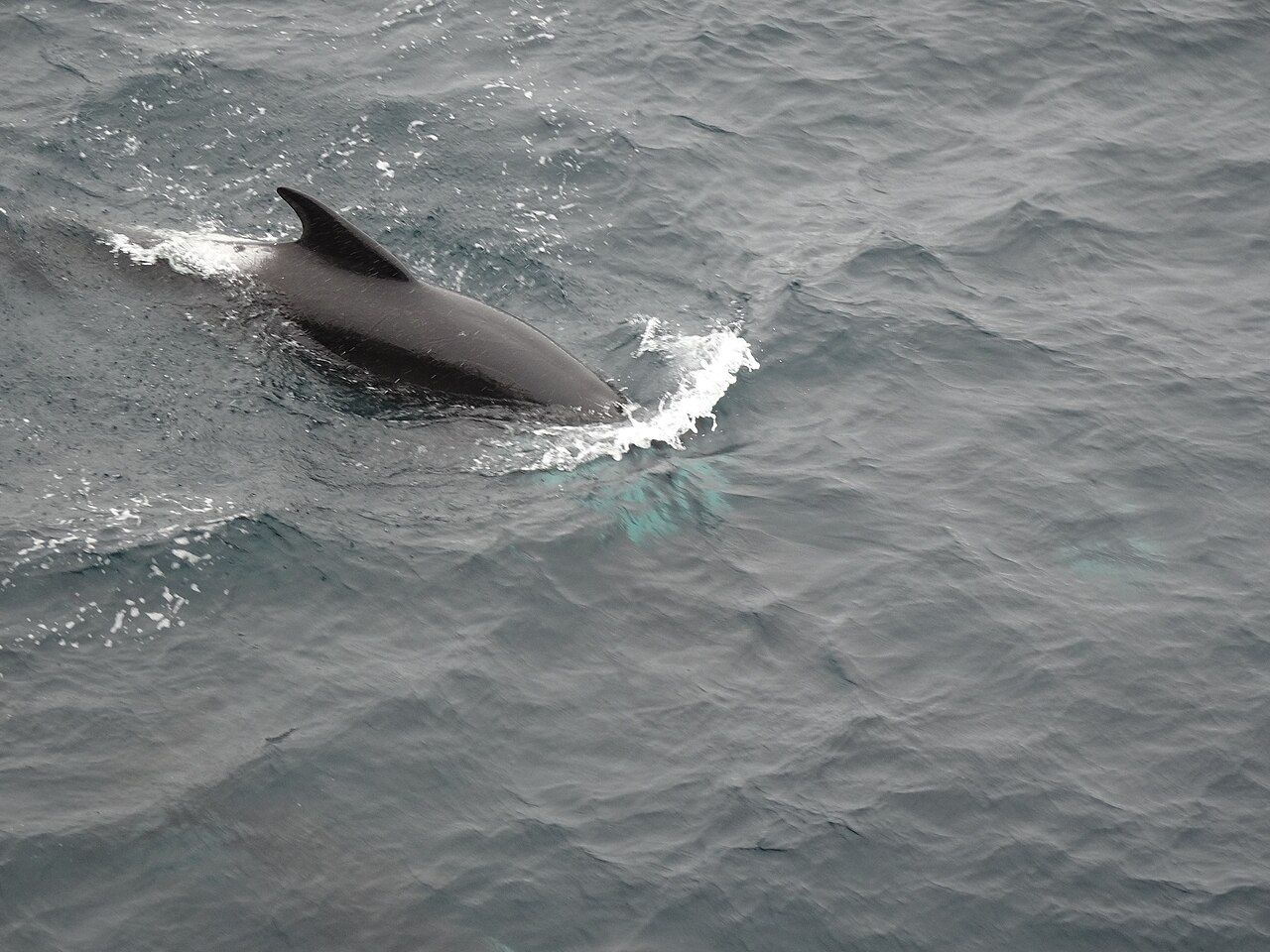 Photo by Sastognuti; CC BY-SA 4.0 (source file)
The strandings question
Pilot whales are among the species most often involved in mass strandings, when many animals come ashore together. It happens on coasts around the North Atlantic and elsewhere, and Nova Scotia has seen pilot whale strandings over the years. The causes are not fully understood. The strong social bonds that hold pods together are thought to play a part: if one animal becomes sick, disoriented or caught in shallow water, others may follow and stay with it. Gently sloping shores and shallow bays, where echolocation works poorly, may also be involved. Scientists do not agree on a single explanation, and each event probably has its own mix of causes.
If you ever find a stranded or entangled whale, do not try to push it back to sea or pull on lines yourself. Keep people and dogs back, note the place and the number of animals, and report it straight away to Fisheries and Oceans Canada or the regional marine animal response line. Trained responders know how to assess an animal and when a refloat has a chance of working.
A whale with a long history
People around the North Atlantic have known pilot whales for centuries. An old Scottish name for the species is the caa'ing whale, from a Scots word for driving, a reminder that pods were once herded ashore and killed in several places. The same habit of following one another that made them easy to drive is part of what puzzles scientists about strandings today. Commercial whaling in Canada ended decades ago, and the whales off Cape Breton are now watched rather than hunted.
Their position in the gulf is not a cause for alarm in the way the North Atlantic right whale is, but pilot whales face the same everyday pressures: noise, fishing gear and changes in their food. The best thing you can do is watch quietly, keep your distance, and enjoy the sight of a family travelling together along one of the steepest coasts in eastern Canada.
Back along the coast: Cabot Trail · Further on: Gulf of St. Lawrence · Same stretch: Gulf of St. Lawrence, Pleasant Bay, Gulf of St. Lawrence, Cape Breton Highlands, Anywhere · the whole coast · logbook