Whales and the gulf
Minke and fin: the gulf's two rorquals
One is the smallest baleen whale you are likely to see off Cape Breton, the other the second-largest animal alive. Both are grey, both have a small fin, and telling them apart takes practice.
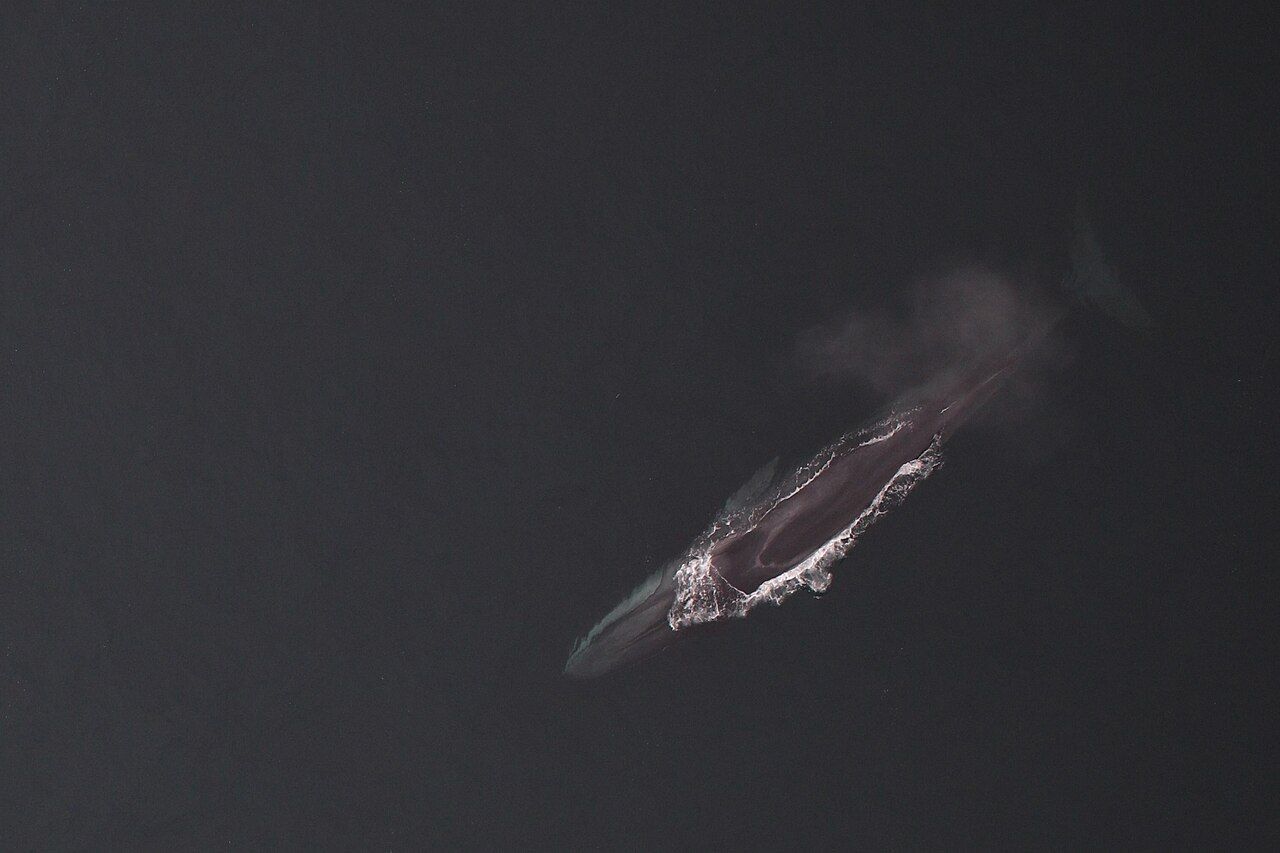 Photo by Laura (Laney) White (USGS Western Ecological Research Center); PD source file
- Getting there
- Offshore along the Cabot Trail's gulf coast
- Bring
- Binoculars and a notebook for blow and fin
- At sea
- Minkes often feed close inshore; fin whales favour deeper water further out. Both are easiest to spot on calm, flat days.
- From Chéticamp
- Offshore all along the west coast
Most people who watch whales off Cape Breton come hoping for a humpback's flukes or a pod of pilot whales. Two other whales share the same water and are seen often: the minke and the fin whale. They are close relatives, both members of the rorqual family, and from a distance both show little more than a grey back and a small curved fin. Up close they could hardly be more different in scale.
Two whales from one family
Rorquals are baleen whales with long pleated throats. When they feed, they open their mouths wide and the grooves along the throat expand like a balloon, taking in a huge gulp of water and prey. The water is then pushed out through plates of baleen that hang from the upper jaw, and the fish or krill stay inside. Humpbacks, blue whales, minkes and fin whales all feed this way.
The minke is the smallest rorqual in the North Atlantic. The fin whale is the second-largest animal on earth, behind only the blue whale. Seeing both in a single summer gives you a sense of just how wide the range is within one family.
The minke: small, quick and quiet
A common minke whale (Balaenoptera acutorostrata) in the North Atlantic usually measures somewhere around seven to nine metres. Its head is narrow and pointed, and North Atlantic minkes have a clear white band across each flipper, which you may see if one passes close by in clear water.
Minkes are easy to miss. Their blow is low and often invisible, so the first sign is usually the back itself. The pointed snout breaks the surface, and the blowhole and the curved dorsal fin appear almost at the same time, before the whale rolls under again. Minkes rarely lift their flukes. They often travel alone or in twos, and they can be unpredictable, surfacing a few times in one place and then turning up far away.
They also come close to shore. Minkes are regularly seen in bays and near headlands along Cape Breton's coasts, which makes them one of the better species to look for from land.
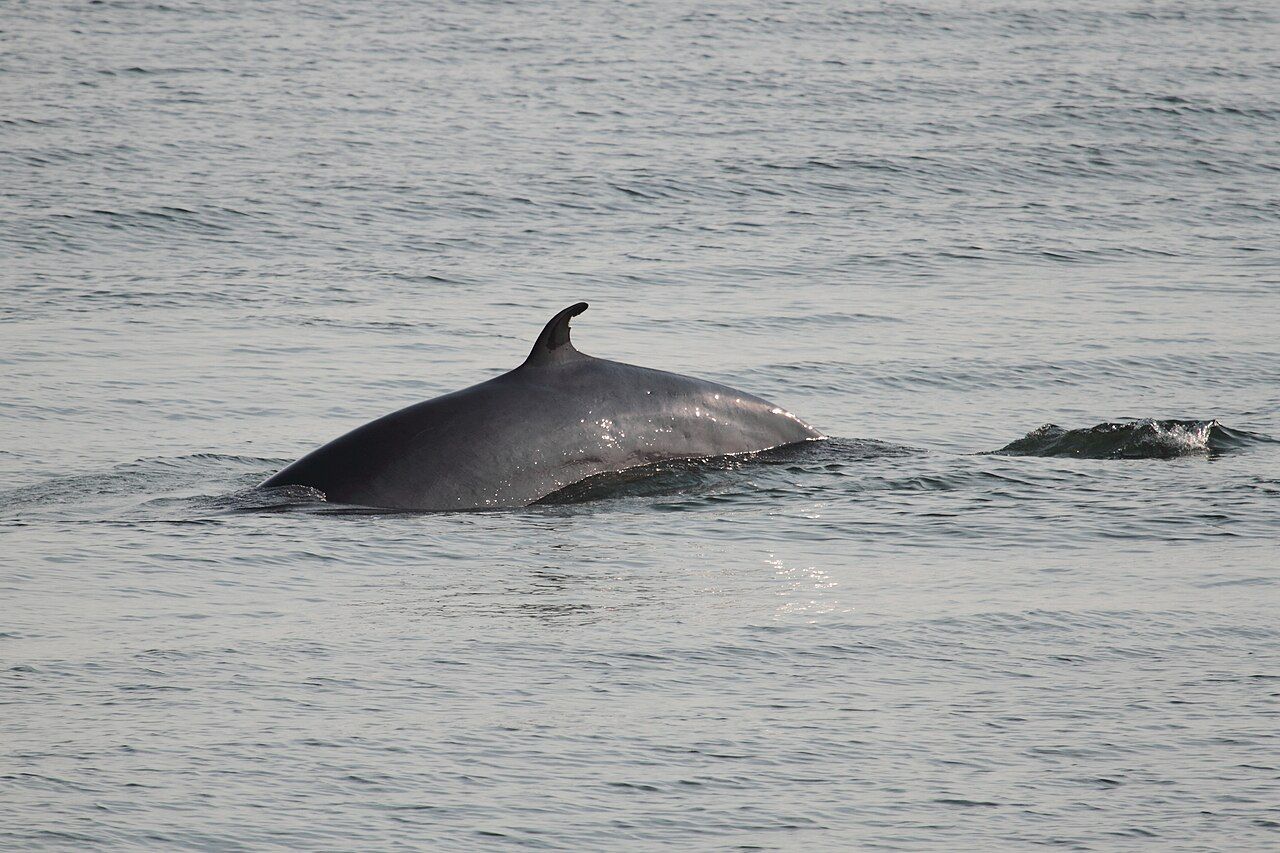 Photo by Cephas; CC BY-SA 3.0 (source file)
The fin whale: tall blow, long back
The fin whale (Balaenoptera physalus) is built for speed: long, slim and streamlined, it has been called the greyhound of the sea. In the North Atlantic adults commonly reach around 18 to 20 metres. When one surfaces, the blow comes first, a tall, narrow column that can rise several metres and hang in still air. Then comes a long, long stretch of back, rolling past for what feels like an age before the small, swept-back dorsal fin finally appears.
The most unusual feature is the colour of the head. The lower jaw is white on the right side and dark on the left, and the pattern carries on into the baleen. It is one of the few strongly asymmetric markings in the animal world, and it is clearest from a boat or a high cliff. Fin whales, like minkes, seldom raise their flukes when they dive.
Further along the coast: Humpbacks of the north coast
Fin whales tend to keep to deeper water and are more often seen offshore than from the beach. In Canada's Atlantic waters the species is listed as being of special concern, and like other large whales it faces risks from ship strikes and entanglement.
Telling them apart at a glance
| Feature | Minke | Fin whale |
|---|---|---|
| Length | About 7 to 9 metres | Up to around 20 metres |
| Blow | Low, often invisible | Tall, narrow and easy to see |
| Fin and back | Fin appears almost with the blowhole | Long back rolls before the fin shows |
| Markings | White band on each flipper | White right lower jaw |
| Where | Often near shore | Usually further out |
The single most useful clue is timing. With a minke, the fin shows up almost as soon as the head breaks the surface. With a fin whale, you see blow, then a great deal of back, then the fin. If you can see a blow at all from shore, you are probably not looking at a minke.
What brings them here in summer
Both species come into the Gulf of St. Lawrence to feed in the warmer months. Cold, mixed water along the edges of the gulf supports dense swarms of krill and schools of small fish such as capelin, herring and sand lance. Minkes take mostly small fish; fin whales take krill as well as fish. Feeding fin whales sometimes lunge sideways at the surface, showing the pale side of the head.
Numbers vary from year to year and month to month with the food. Both are usually around from early summer into the autumn, though neither can be promised on a given day.
Where you see one, look for others. Feeding whales of different species often gather over the same patch of fish, so a minke working along a headland may share the water with pilot whales, seals and diving seabirds. A fin whale offshore can be the first sign that a much larger feeding event is under way further out.
Watching them well
Patience is the main skill. Scan a wide arc rather than fixing on one spot, and look for anything that breaks the pattern of the waves. From high ground on the Cabot Trail, the lookouts above the gulf give you long sightlines; down at sea level, a still morning helps most.
If you go out on the water, the same distance rules that protect other whales apply here, and a fin whale moving at speed can cover a lot of water quickly. Keep well back, never chase, and let the whale choose the course. The guide to watching whales well covers the rules in general terms.
Back along the coast: Gulf of St. Lawrence · Further on: Pleasant Bay · Same stretch: Gulf of St. Lawrence, Pleasant Bay, Gulf of St. Lawrence, Cape Breton Highlands, Anywhere · the whole coast · logbook